Tom Keefer
The Caine Mutiny Court-MartialTom Keefer is a communications officer, aspiring writer, and perceptive but compromised critic of command aboard the USS Caine. He helps give language to the officers’ growing distrust of Captain Queeg, identifying what he sees as the captain’s delusions; but when acting on that diagnosis risks his own career, Keefer retreats. His eventual departure from the USS Caine brings that contradiction into focus: he leaves as a captain, yet tells Willie Keith, “Don’t forget one thing. I jumped.”
Identity and Background
Keefer is Roland Keefer’s older half brother. Their father’s first marriage was to a Catholic woman from Boston; after the marriage ended, she returned there with Tom. Roland tells Willie Keith that the brothers have seen little of one another and are sharply different in temperament. He describes Tom as a highbrow who writes short stories and plays, has published work in magazines, and earns money from it. At William and Mary, Tom was already a senior when Roland was a freshman, and he moved among literary friends with whom Roland felt out of place. Roland suspects Tom considers him a moron, though he also calls his brother witty and not a bad man.
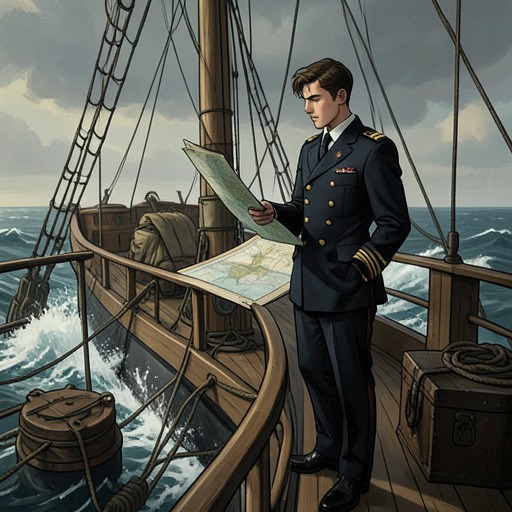
When Willie meets him in Pearl Harbor, Tom is over six feet tall, small-boned and lean, with deep-set blue eyes and a wide mouth whose narrow, pale lips contrast with Roland’s fleshy ones. The contrast makes the brothers’ difference visible before Willie knows much about Tom’s character. Tom’s cabin, meanwhile, gives a more direct account of his intellectual life: shelves hold poetry, fiction, and philosophy, including Joyce, T. S. Eliot, Proust, Kafka, Dos Passos, and Freud, alongside books on psychoanalysis and Catholic publications. He tells Willie that he had been trying to become a writer before the war and that reading helps make the slow life at sea bearable.
Work and Literary Temperament
Tom introduces Willie to the routine of the communications department by assigning him custody of registered publications and coding duties. The exchange places literary ambition beside naval procedure: Tom has not left the Navy’s technical work behind, even though he regards shipboard life as intellectually stifling. His books and his writing are not simply a private hobby; they shape the interpretive habits he brings to the USS Caine’s problems.
Those habits make him quick to turn incidents into explanations. During the dispute over the missing strawberries, Tom offers Steve Maryk a psychological account of Captain Queeg’s behavior. He argues that Queeg has built a fantasy around a supposed duplicate key and is reenacting an earlier cheese investigation to restore his shaken sense of himself. In Tom’s reading, the strawberries are incidental: Queeg needs a detective story in which he can again imagine himself the successful investigator. Tom’s account is forceful and coherent, but its certainty exceeds what he can prove. He dismisses the simpler explanation that the mess boys ate the fruit while treating the captain’s imagined key as evidence of a larger mental disorder.
Opposition to Queeg
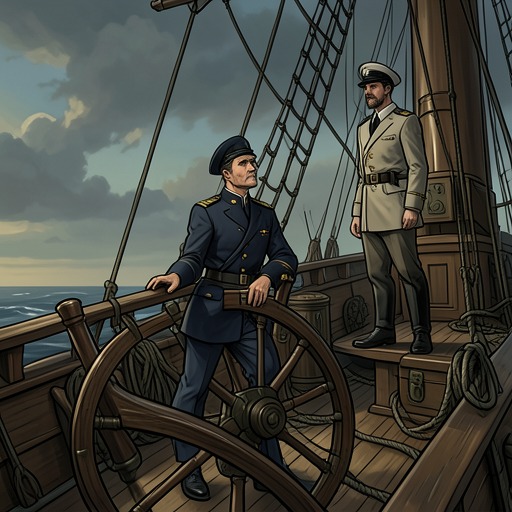
Tom’s criticism of Queeg becomes more openly consequential after the matter involving John Stilwell. In a conversation with the officers, Tom insists that they are responsible for the ship’s safety and should face the situation realistically; he calls Queeg a poltroon. The declaration is striking because Tom makes it just before Queeg enters the room and asks for coffee. Tom serves him courteously. The scene sets his fluent condemnation against the civility required by the chain of command, and shows how easily judgment can remain talk rather than action.
Tom then raises the possibility that Queeg is insane with Maryk. He presents the question gravely, not as a joke, and says he has not spoken about the matter since the Stilwell affair because the current situation has crossed a line. In doing so, he helps move Maryk’s concern from frustration with a difficult commanding officer toward a diagnosis of incapacity. Tom is not merely a bystander to Maryk’s thinking: his language gives the executive officer a framework for interpreting Queeg’s conduct and its implications for the USS Caine.
The Halsey Attempt and Retreat
When Maryk and Tom reach the area of Admiral William F. Halsey’s quarters, Maryk considers going in and appealing directly to the admiral, even if doing so means breaking the chain of command. Tom instead pulls him away from the guarded entrance. He says he is getting cold on the plan and contrasts the USS Caine with the USS New Jersey: the larger Navy, he argues, is the real institution, while their own ship is effectively a floating madhouse. He believes that trying to invoke Article 184 against Queeg will ruin them and that they have no chance.
The withdrawal exposes the weakness in Tom’s earlier realism. He has urged Maryk to face what he calls the facts about Queeg, but at the threshold of a consequential appeal, he imagines the institutional consequences and backs away. His intelligence lets him anticipate danger; it does not make him willing to accept its cost. Maryk is left to carry forward the crisis that Tom helped explain but no longer wants to confront alongside him.
Command, Departure, and Confession
After Japan’s surrender, the Navy’s new point system releases half the USS Caine’s crew and Captain Queeg. Tom summons Willie and asks whether he is ready to take over the ship. He argues that Willie’s two years of wartime cruising qualify him, cites his own positive assessment of Willie in the June officers’ roster, and proposes seeking a dispatch through MinePac and the Bureau of Personnel rather than waiting for the normal relief process. Tom is therefore willing to use his authority and initiative to arrange Willie’s promotion to command.
Three days later, a coded action message confirms that Willie is captain. Tom has been packing since the new point system arrived, and within minutes of the message the crew assembles for the transfer of command. As the two officers wait at the gangway with Tom’s bags, Willie suggests that Tom might have stayed aboard for the voyage through the Panama Canal and the ship’s eventual disposal. Tom rejects the prospect. He describes the anticipation of freedom as overwhelming and says that waiting for the gig feels longer than a month under Queeg, which in turn felt longer than ten years of ordinary life.
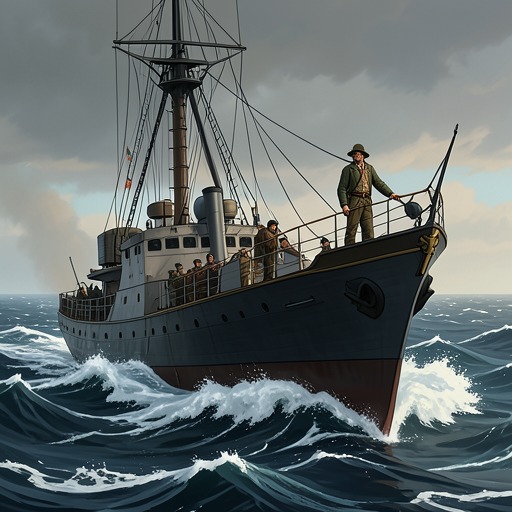
Tom’s farewell makes the ship itself the object of his accumulated resentment. Looking at its rusty deck and peeling stacks, he says he has hated the USS Caine throughout his thirty-five months aboard and feels that his hatred is only deepening. He calls it an iron poltergeist sent to ruin his life, then asks Willie to lay his ghost. The extravagant metaphor belongs to the novelist, but the departure is immediate and practical: when the gig arrives, Tom shakes Willie’s hand, salutes, and goes down the ladder.
Just before leaving, Tom tells Willie, “Don’t envy me my happiness too much, Willie. Don’t forget one thing. I jumped.” The admission redefines the confident critic who had diagnosed Queeg and warned Maryk about the danger of the USS Caine. Tom is not simply departing for freedom or a literary future; his last words acknowledge that, during the typhoon crisis, he abandoned the ship. His insight into other men’s failures therefore ends in an unusually direct recognition of his own.